
It’s the start of Winter and for this Chicago Disc Golfer, the change of season has had a lot of meaningful implications:
- It’s dark outside when I leave work.
- Walking Gordon is not nearly as much fun as it was a couple months ago.
- Days that allow for enjoyable disc golf are few and far between.
Since I’m not able to practice nearly as much as I’d like to, my mind has had a little too much time to wander… a scary thought, I know.
With so much time on my hands, I began to reflect on the 2021 disc golf season. At the onset of this year, I made a conscious effort to rid myself of the “play-it-safe” mentality. Sometimes, this more aggressive approach worked out in my favor, other times not so much. It was fairly easy to track how my PDGA rating changed over the course of the year, but I began asking myself questions that weren’t as easy to find the answers to. Does an aggressive approach lead to greater round rating volatility? Conversely, does a conservative approach lead to more consistent round ratings? In what years were my top events of all time?
In general, I am a fan of the PDGA’s rating system (stay tuned for a blog-post explaining why), but a player’s rating at a given point in time fails to convey two vital pieces of information:
- It is not directional or predictive
- It is not indicative of volatility
It’s time consuming and tedious to go to a player’s PDGA page, get information on all the rounds and events they’ve played, then summarize the information in a way that allows for prediction. That’s why I developed the Disc Golf Player Summary, which instantly tells a deeper story of a disc golfer and their rating.
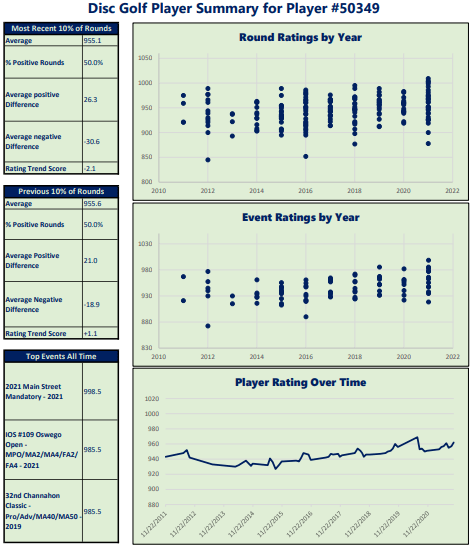
The Disc Golf Player Summary highlights trends from PDGA sanctioned tournament round performance (sanctioned leagues are not included). Specifically, it looks at how a player performs in a given round relative to their Player Rating at the time. When a player’s round rating is higher than their player rating at the time of the round, it is referred to as a positive round, and the difference between the round rating and the player’s rating at the time is called the positive round difference. For example, when a 950 rated player shoots a 980 rated round, the round is a positive round with a positive round difference of 30. Similarly, rounds below a player’s rating are considered negative rounds, with the difference between the player rating and round rating referred to as negative round difference. When a 950 player shoots a 920 rated round, this round is considered a negative round with negative round difference of -30. Here’s the information you’ll get out of the Player Summary:
What is the Probability of a Positive Round?
Since player rating is regularly changing, it is insufficient to use traditional traditional statistics like mean and standard deviation to predict player performance. Players who are regularly outperforming their player rating might be more likely to have success than their player rating would otherwise indicate. The Summary compares positive round likelihood from the most recent 10% of rounds to that of their previous 10% of rounds
What is Average Positive Round Difference? How about Average Negative Round Difference?
This number tells us how volatile the player is. When they shoot well, are they beating their player rating by a significant margin? Or are they always within a few points of their player rating? Conversely when they shoot poorly, are they completely falling apart, or are they salvaging their negative rounds to avoid plummeting down the leaderboard? Again, the Summary sheet compares these metrics from a player’s most recent 10% of rounds to their prior 10% of rounds.
Do the positive rounds outweigh the negative rounds?
This metric, coined the Rating Trend Score, can be thought of as expected points a player will shoot below or above their round rating. It is defined as:
% Positive Rounds * Average Positive Round Difference + % Negative Rounds * Average Negative Round Difference
Which events are the player’s best and when did they happen?
This fairly innocuous question is actually a kind of a beast to answer definitively on the PDGA player page, though its answer can provide significant insight into the direction a player is headed. If their top 3 events are all recent, then there’s a good chance they are on their way up the leaderboard at their local tournaments.
Here’s how the Player Summary works:
- Download the Excel document
- Upon opening click Enable Content if prompted
- Click the Generate the New Report button
- Enter in your PDGA # (or your friend’s, or Paul McBeth’s, whoever!)
- Enjoy the Player Summary…
- Repeat steps 2 through 4 indefinitely!
 Hyzermetrics